The WebAIM Million 2026 reverses years of gradual improvement - 95.9% of pages fail WCAG. Steve Frenzel names four roles for sneaking accessibility into resistant organisations. And why the ARIA APG is not a pattern library.
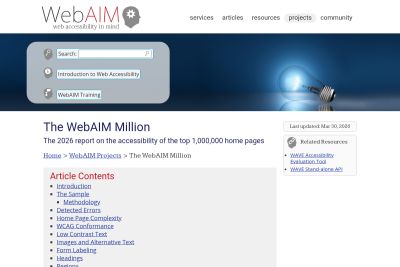
The 2026 WebAIM Million reverses years of gradual improvement: 95.9% of home pages now have detectable WCAG failures (up from 94.8%), averaging 56.1 errors per page - a 10% increase. Home page complexity nearly doubled since 2019 (1,437 elements average), ARIA usage exploded 6x to 133 attributes per page, and pages with ARIA have 17 more errors than those without. The six most common issues (low contrast, missing alt text, missing labels, empty links/buttons, missing language) account for 96% of all errors. Astro leads frameworks at 9.0 errors per page; Shopify and Prestashop are among the worst.
Steve describes four roles for sneaking accessibility into organisations that resist it: the Adviser (influence tech choices early), the Mediator (review designs pre-handoff), the Smuggler (fix issues during regular work, fund accessibility hours through SEO overlap per Amber Hinds), and the Coder (add linters, pre-commit hooks, block PRs).
Tracy identifies eight trends defining the accessibility crisis of 2026. From AI captioning that drops sentences and fabricates words, to an ASL interpreter shortage driven by burnout and low pay, to alt text that reads 'image' instead of describing content - the piece argues that innovation accelerates while accessibility stagnates. The only optimistic trend: disabled creators and leaders increasingly shape the conversation on their own terms.
Chris argues that accessibility failures aren't design oversights - they're engineering failures. The full-stack hiring trend stripped teams of specialist front-end knowledge, while AI tools like Copilot generate broken code at scale for engineers without foundations. Automated tooling catches only 30% of issues (per UK GDS research), yet most organisations treat compliance as done after running axe. Nine months after the EAA deadline, the gap between ticking WCAG boxes and building genuinely usable interfaces keeps widening.
Stefan challenges treating the W3C ARIA Authoring Practices Guide (APG) as the definitive source for accessible components. Referencing Eric Bailey, he points out the APG disproportionately favours ARIA in its examples because it demonstrates capabilities, not best practices. It also doesn't account for assistive technology support gaps across browser-screen reader combinations. The valuable parts: standardised pattern naming, 'About This Pattern' descriptions, and keyboard interaction specs. His advice: prioritise native HTML, test with actual screen readers, follow practitioners like Adrian Roselli who publish real-world testing findings.
The official Nuxt accessibility module integrates axe-core directly into Nuxt DevTools, giving developers real-time violation feedback during development. Key features include element highlighting with numbered badges, impact-based sorting (critical to minor), route tracking across navigation, and auto-scan mode triggered by user interactions. It also generates markdown reports at build time with a failOnViolation flag for CI pipelines.
Working Draft episode 687 features guest Jens Oliver Meiert, discussing why HTML conformance matters for professional frontend work. Meiert's annual analysis of the top 200 websites reveals that zero had valid HTML in 2025 - continuing a trend since 2022. The conversation covers the gap between HTML craftsmanship and modern tooling, why the removal of WCAG criterion 4.1.1 (Parsing) doesn't make validity optional, the role of HTML minification via Meiert's maintained fork of HTML Minifier, and how optional markup and default attributes can reduce document size while staying conformant.
Thank you for registering!
I have already sent you the first email and kindly ask you to confirm your email address via the activation link.