Accessibility Espresso #6 ☕
June 10, 2026
|
|
{if %lastname != ''}{if %gender == 'female'}Dear Ms{elseif %gender == 'male'}Dear Mr{else}Dear Ms / Mr{/if}{if %title != ''} {%title}{/if} {%lastname}{else}Dear Reader{/if},
welcome to the new issue, this time featuring the following topics:
A Book Apart's 'Accessibility for Everyone' by Laura Kalbag - a paid book since 2017, now completely free. Anna E. Cook explains why AI depends on accessible systems instead of fixing them. Eric Eggert: screen readers aren't testing tools.
I wish you an enjoyable read.
Best regards,
Jan Deppisch
|
|
⭐ Topic of the Week
|
|
|
Sam, Laura Kalbag's brother with cerebral palsy, spends nine hours a day online but needs two to three times longer for every task. His story opens 'Accessibility for Everyone', published by A Book Apart in 2017 and now free as a complete web edition. Kalbag covers five disability categories with hard numbers - 12.1% of the US population, up to 8% colour blindness in men, 35% of over-40s with vestibular disorders - and moves from copywriting to HTML semantics and testing with JAWS, VoiceOver and NVDA. Her argument: accessibility is not a budget line but an underlying practice.
|
|
|
📋 The Bigger Picture
|

|
|
Anna E. Cook argues the industry has the logic backwards. AI cannot repair a broken structure - it inherits it and reproduces it at scale. She points to the WebAIM 2026 Million report, where 95.9% of homepages fail WCAG and errors per page rose 10.1% in a single year, the first regression in six years. Microsoft's own LLM evaluation scored models at 0-31% WCAG compliance, GPT-5 Mini highest at 31%. She dismantles four myths, including Jakob Nielsen's diagnosis-based generative UI. Her conclusion: not every product needs AI, but every product needs accessible, well-designed systems.
|
|
|
|
|
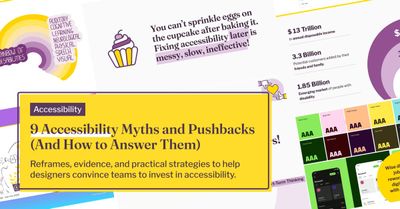
Stéphanie Walter tackles the hard part of accessibility - convincing other people. She catalogues nine common objections and arms designers with data and a reframe for each. Against 'no one complained', a 2019 Nucleus study found 23% of e-commerce transactions abandoned by blind users, $6.9 billion lost yearly. Against 'too expensive', Forrester (2022) found $100 returned per $1 invested. Against 'we'll fix it later', IBM's defect-cost curve runs 1x in design to 100x in maintenance, and Deque finds 67% of issues originate in design. Her line: legal compliance is the floor, not the ceiling.
|
|
|
|
|
The Access-Ability newsletter makes a procurement argument decision-makers rarely hear. The vendor who built your inaccessible site should not be the one you pay to remediate it. The piece compares it to someone throwing sugar in your gas tank at a gas station and then offering to sell you a new engine, and warns that an auditor who stands to win the remediation contract has an obvious interest in how severe the findings look. Missing alt text, poor contrast and unlabelled fields are not edge cases. Its recommendation: an independent audit first, then a separate, competitive remediation contract.
|
|
|
⚙️ In Practice
|
|
|
Eric Eggert argues screen readers should not be an auditor's primary WCAG testing tool. They show the symptoms of bad code, not the actual problems, and need expert operation to read a page correctly. His examples are concrete: a div with tabindex=0 can be activated with VO+Space, so it 'works' though its affordance is broken; bad focus indicators stay invisible because screen readers paint their own always-on focus ring. He points to faster, root-cause tooling - a11y-tools.com bookmarklets, Polypane Peek - and reserves screen-reader checks for live regions and post-fix usability testing.
|
|
|
|
|
Working Draft episode 651 is dedicated entirely to ARIA. The hosts explore the five rules of ARIA and stress that the first - don't use ARIA if a native HTML element can do the job - is violated far more often than developers realise. The discussion covers practical patterns for live regions, aria-label versus aria-labelledby, and landmark roles. They examine how ARIA states interact with the browser's accessibility tree and why incorrect ARIA is worse than no ARIA at all. A roughly 60-minute German-language episode, free and without registration, and a solid starting point beyond the first rule.
|
|
|
|
|
Manuel Matuzovic re-tests a best practice many apply on autopilot - adding tabindex=-1 to a skip link's target. Browsers have long implemented the Sequential Focus Navigation Starting Point (Firefox in 2013, Chrome in 2016), so after a skip link, Tab continues from the target without the workaround. He verifies this across Firefox, Chrome, Safari and Edge on macOS and Windows, plus VoiceOver, JAWS 2026, NVDA, Narrator, TalkBack and Screen Magnifier at 700%. The catch: Dan Burzo found tabindex=-1 on a main element can break the iOS back button. Re-evaluate practices you have followed for years.
|
|
|
|
View in browser
Unsubscribe
|
|
|
© 2026 Jan Deppisch ·
jandeppisch.de
|
|