Accessibility Espresso #1 ☕
16. Februar 2026
|
|
{if %lastname != ''}{if %gender == 'female'}Dear Ms{elseif %gender == 'male'}Dear Mr{else}Dear Ms / Mr{/if}{if %title != ''} {%title}{/if} {%lastname}{else}Dear Reader{/if},
welcome to the first issue! We start with the following topics:
1,001 experts sign the Overlay Fact Sheet, Eric Bailey predicts EAA compliance theater, and how AI changes the way we write alt text.
I wish you an enjoyable read.
Best regards,
Jan Deppisch
|
|
⭐ Topic of the Week
|
|
|
Eric Bailey, Senior Designer for Accessibility & Design Systems at Github, predicts that the European Accessibility Act will trigger the same pattern as GDPR: a wave of third-party vendors selling performative compliance rather than genuine solutions. He points to accessibility overlay companies already facing FTC action and class-action lawsuits (e.g., UserWay) as evidence. Bailey argues that most access barriers originate in the design layer, not in code - and that LLMs trained on the largely inaccessible web will perpetuate these problems. His central warning: the gap between contractually-guaranteed accessibility and actually usable experiences will keep widening.
|
|
|
📋 Strategy & Compliance
|
|
|
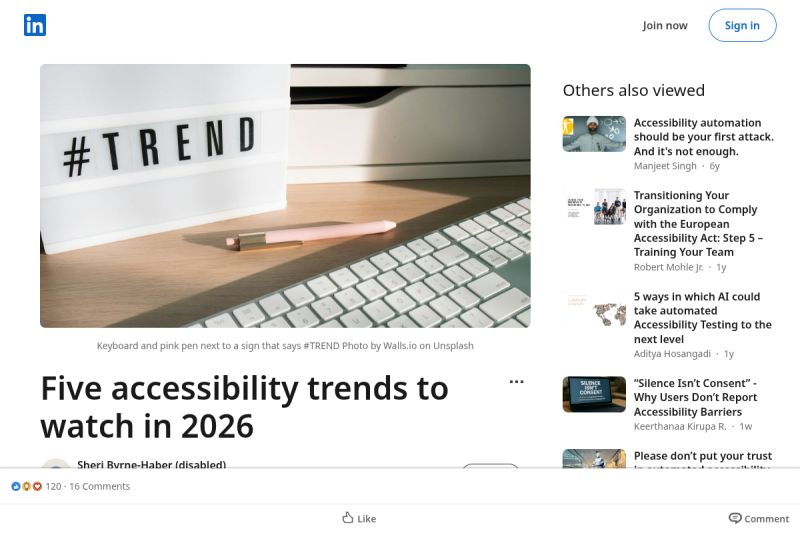
Sheri Byrne-Haber identifies five shifts that will define accessibility work in 2026. AI-assisted testing moves from optional to expected — teams that lack it will fall behind modern development cycles. Maturity models evolve from one-time assessments into strategic roadmaps addressing governance, design, and culture. Accessibility metrics finally connect to business outcomes like conversion rates and support volume. And rich media gets judged on whether captions actually help people understand, not just whether they exist.
|
|
|
|
|
Léonie Watson (TetraLogical) explores how agentic AI reshapes accessibility: a blind user shopping for a jumper finds only 'Long sleeve, crew neck, black' — no texture, length, or weight. Innosearch's CoBrowse (serving 500,000 stores) lets users search, filter, and buy via voice, bypassing inaccessible websites. But with 2.5 billion daily ChatGPT prompts (up from 1B in Dec 2024), Google traffic down up to 50% from AI search, and 14 billion daily search requests: how do we test accessibility in non-deterministic systems?
|
|
|
|
|
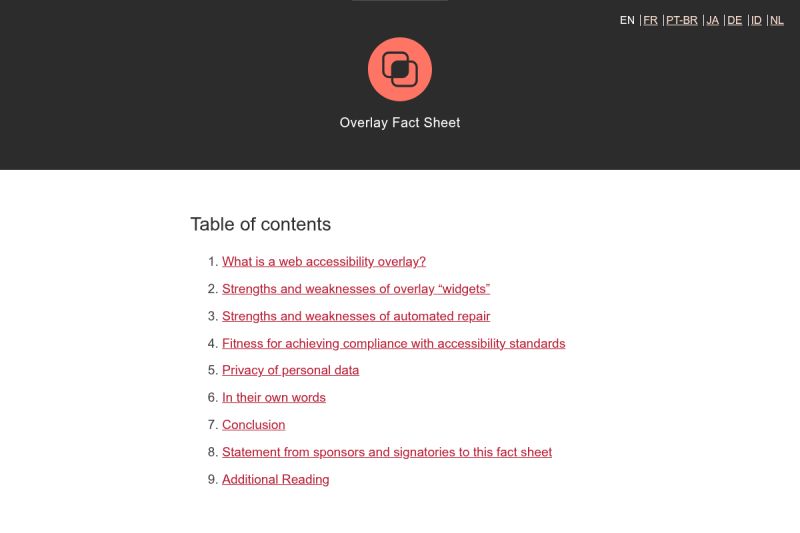
An open letter signed by 1,001 accessibility professionals — including W3C spec editors, staff from Google, Microsoft, Apple, BBC, and Shopify, plus assistive technology developers (JAWS, NVDA). Core argument: no overlay product can achieve full WCAG compliance because automated tools detect at most 30% of issues. WebAIM survey data: 67% of practitioners rate overlays as ineffective, 72% of respondents with disabilities agree. The document also flags privacy violations — overlays detect assistive technology use, exposing disability status without consent, creating GDPR and CCPA risks.
|
|
|
⚙️ In Practice
|
|
|
Elle Smith's guide starts where most fail: 'Invalid input' helps no one. The fix is a four-part pattern — error summary with jump links, inline messages per field, multi-modal cues (not just red borders), and focus management via tabindex='-1'. Key detail: use novalidate to override inconsistent browser defaults. Includes a working CodePen and references Adrian Roselli's work on avoiding native validation.
|
|
|
|
|
Jared Cunha tested Claude Sonnet 4 with the same Union Station photo through five progressive prompts. 'Describe this image' produced an essay. 'Write alt text emphasizing the renovation' focused on restoration details. '…about declining ridership' highlighted sparse foot traffic. Same image, different context, completely different alt text. Key insight: 'Writing a prompt requires much less mental effort than manually writing alternative text from scratch' — it's about reducing cognitive load, not keystrokes.
|
|
|
|
|
Nina Jameson (Gehirngerecht Digital) explains WCAG navigation shortcuts: W3C's 'Understanding' docs explain intent behind each success criterion, 'How to Meet' provides techniques. Her tool picks: axe DevTools and ARC Toolkit over Lighthouse. References BfIT-Bund guidance on typical interface elements. Plus: how the BFSG impacts daily development work. 65-minute episode with full transcript.
|
|
|
|
View in browser
Unsubscribe
|
|
|
© 2026 Jan Deppisch ·
jandeppisch.de
|
|